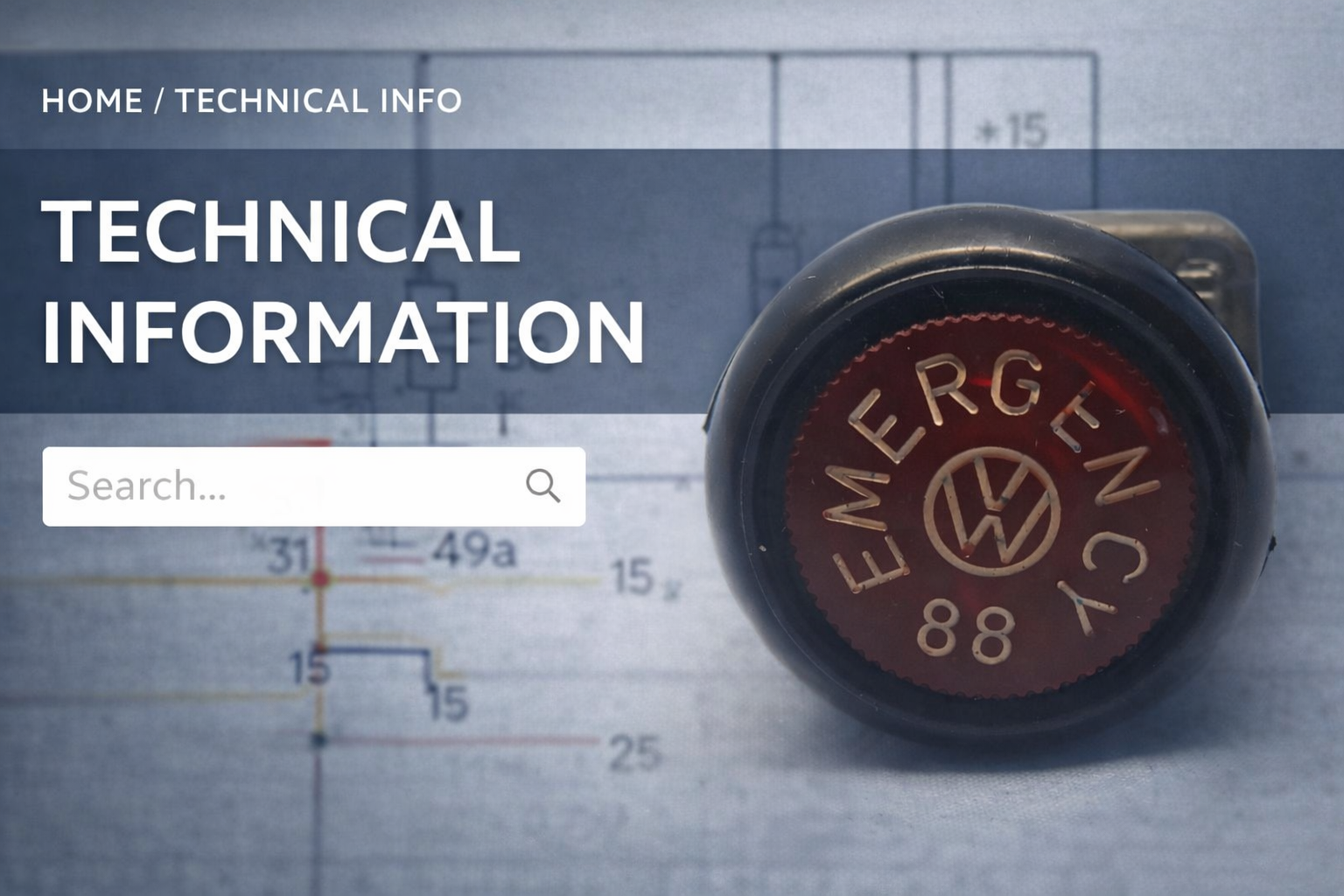
VW Wiring Numbers Explained (What “88” Means, Plus the Common Circuits)
Posted by: Kate McCarthy
Category: Electrics
Last updated: January 2026
If you’ve ever pulled a switch out of the dash on an aircooled Volkswagen (Beetle, Bay, Split, Karmann Ghia, Type 3 etc.), you’ll have seen odd numbers moulded into the plastic and wondered what they mean.
One that comes up a lot is the hazard switch, which often has:
EMERGENCY
88
So what does 88 mean? And what about the other numbers like 30, 15 and 31?
Why VW Uses Numbers Instead of Labels
Volkswagen (and most German vehicles of the era) use a standardised electrical numbering system called DIN terminal numbers. Instead of writing “battery live” or “ignition live”, they use a number. This means wiring diagrams, switches, relays and looms can all use the same “language”.
Once you learn the common ones, wiring suddenly starts to make a whole lot more sense.
So… What Does “88” Mean on the Hazard Switch?
88 is used to identify the hazard / emergency flasher circuit.
So when you see EMERGENCY 88 on the switch, it’s basically saying:
This switch relates to the hazard warning circuit (terminal group 88).
It’s not a date, not a year, and not a model reference. It’s simply VW’s circuit identification.
The Most Common VW Wiring Numbers (Quick Reference)
| Terminal number | Function |
|---|---|
| 30 | Battery positive (permanent live) |
| 15 | Ignition live (only live with key on) |
| 31 | Earth / Ground (negative) |
| 49 | Flasher relay power in (indicator / hazard feed) |
| 49a | Flasher relay output (pulsed output to indicators / hazards) |
| 54 | Brake light circuit |
| 56 | Headlights circuit |
| 58 | Side/parking lights & dash illumination (varies by suffix) |
| 88 | Hazard / emergency flasher circuit |
Tip: When testing with a multimeter:
- Terminal 30 should be live all the time.
- Terminal 15 should only be live with ignition on.
- Terminal 31 should be a good earth (ground).
Why This Helps (Especially for Fault-Finding)
Understanding these numbers makes fault-finding faster and less stressful. Instead of guessing which wire does what, you can work logically.
- If your hazards don’t work, you’ll usually check for power at 30, then confirm the flasher feed/output 49 / 49a, then work through the hazard switch connections (often involving 88 depending on switch style).
- If your indicators are dead, you’ll often end up checking relay connections at 49 and 49a, and earths at 31.
Wiring Diagrams Are Your Best Friend
If you’re working on your electrics, a good wiring diagram is essential. The terminal numbers on the diagram match the terminal numbers on the actual parts. That’s exactly why VW did it this way.
We’ll be building up a growing Classic Volks technical library over time (with simplified circuit guides too), so keep checking back.
Want Us to Cover a Specific Circuit Next?
If you’d like a Classic Volks guide on a specific system (hazards on early bays, charging circuits, ignition, lighting faults, indicator relays, etc.), drop us a message via the contact page and we’ll add it to the list.